I've had several teachers tell me that the best ideas come in the middle of the night, and I should keep a notebook by my bed so I can write down all these things that end up forgotten by morning.
What they don't tell you is that in that semi-sleep state, the mind generally talks itself back into sleep before any action happens in the writing aspect. One time, I did half wake up thinking I should write down some random piece of thought, but I couldn't see what I was doing. I guess I was too asleep to think to turn on the light.
Last night, I woke myself up with profoundities and determined to record these gems of thought before they slipped away. I did manage to get the light and find a pen. Odd thing is, in the morning, none of it made any sense.
Maybe it works for some--I think I'll stick to writing when I'm awake.
Thursday, September 13, 2007

Monday, September 10, 2007
Unfinished
Twenty-five pages between myself and the conclusion of the book. I've raced through the climax, rising and falling with the intended emotions. The antagonist still lives, but I am confident his fate is settled.
All that remains is the explanation. It is the point of no return in a book. It is the downward slope from here to the end that will only accelerate, gaining momentum until the final word.
This is the revealing in which the characters fianlly learn the why and how, the moment that finally uncovers the story behind the story that has kept the reader intrigued since about page 50.
Twenty-five pages remain, and I am already two minutes late for work. I cannot justify taking a moment more. I am condemned to a few hours of agony.
Many years back, I picked up a book that facinated me. It was a mystery, some sort of library reject I had picked up for a quarter. I came to the end only to discover the last chapter and a half had been torn from the spine. I was cut off mid sentense, left in a dreadful suspence that was never satisfied. Title and author have been lost to time, but I cannot forget the settled unknowing.
Kind of an odd time in life. Feels like I'm suspended in that point twenty-five pages from the end. I've passed through all the elements of a story, seen the conflict, the rise of the climax, observed the character changes. I've stood face to face with the enemy. He still lives, but his demise is decided. I've endured the sacrifices, but can safely assume the outcome.
All that remains is the revealing. All I need to know now is the why--why the events transpired as they did, how good is to be rewarded, how evil will be destroyed.
And what if God decides never to tell? What if like a that childhood memory, I never know the final chapter? Perhaps through indefinite agony, all that remains is to trust God's sovereignty.
All that remains is the explanation. It is the point of no return in a book. It is the downward slope from here to the end that will only accelerate, gaining momentum until the final word.
This is the revealing in which the characters fianlly learn the why and how, the moment that finally uncovers the story behind the story that has kept the reader intrigued since about page 50.
Twenty-five pages remain, and I am already two minutes late for work. I cannot justify taking a moment more. I am condemned to a few hours of agony.
Many years back, I picked up a book that facinated me. It was a mystery, some sort of library reject I had picked up for a quarter. I came to the end only to discover the last chapter and a half had been torn from the spine. I was cut off mid sentense, left in a dreadful suspence that was never satisfied. Title and author have been lost to time, but I cannot forget the settled unknowing.
Kind of an odd time in life. Feels like I'm suspended in that point twenty-five pages from the end. I've passed through all the elements of a story, seen the conflict, the rise of the climax, observed the character changes. I've stood face to face with the enemy. He still lives, but his demise is decided. I've endured the sacrifices, but can safely assume the outcome.
All that remains is the revealing. All I need to know now is the why--why the events transpired as they did, how good is to be rewarded, how evil will be destroyed.
And what if God decides never to tell? What if like a that childhood memory, I never know the final chapter? Perhaps through indefinite agony, all that remains is to trust God's sovereignty.
Friday, July 27, 2007
Purpose
I crave purpose.
I want to do something
to be something
to mean something.
I want to rise to the expetations others have imagined for me
To recieve the nod of approval, acceptance
And to know somehow it's enough.
I want to look back on previous years without regret
And towards the future with anticipation.
I want to leave a legacy in flesh and bone.
I want to create a masterpiece that breathes.
I want to touch a life that in time will touch another and in so doing, fulfill a purpose that never dies.
I want to do something
to be something
to mean something.
I want to rise to the expetations others have imagined for me
To recieve the nod of approval, acceptance
And to know somehow it's enough.
I want to look back on previous years without regret
And towards the future with anticipation.
I want to leave a legacy in flesh and bone.
I want to create a masterpiece that breathes.
I want to touch a life that in time will touch another and in so doing, fulfill a purpose that never dies.
Monday, April 23, 2007
You know you're a lifer when...
- Three to four years doesn't seem like a long time to invest in a new degree
- Your freshman roommates are now your professors
- You know the people that the buildings were named for
- Dinner conversation consists of first hand knowledge of how the rules have changed in the past decade
- You wish you could get a t-shirt that reads "I'm from the pre-Radford era"
- You don't rent out books anymore because they are four or five editions too old
- You remember when CSR's were filled out by pencil on bubble forms every Monday
- You can't imagine your life not broken into semesters
- You've seen the same jokes in the Tantalizing Tidbits at least three times
- You survived lice fest
Thursday, April 19, 2007
At war
Heart wringing, mind crushing, soul burning battle. The ceaseless war, ever fought, never won--hopeless, cruel. The mind and the heart at constant odds, unable to resolve their differences. And I caught in the middle, subject to both petty discrepancies and the full, lash out thirst for blood.
Heart, once nurtured, cease to feel. Your embrace, once gentle, begins to strangle. I suffocate. Mind, once pursued, cease your reason. Your thoughts, once stimulating, grow wearisome. I stagger beneath the weight.
Heart and mind, will neither win? Will you reach no resolution? Then at least release me from your tiresome charade. I want no part of either.
Heart, once nurtured, cease to feel. Your embrace, once gentle, begins to strangle. I suffocate. Mind, once pursued, cease your reason. Your thoughts, once stimulating, grow wearisome. I stagger beneath the weight.
Heart and mind, will neither win? Will you reach no resolution? Then at least release me from your tiresome charade. I want no part of either.
Friday, April 13, 2007
Purple Like Rap
- There is a distinction between being unteacheable and standing firm in your convictions
- Those who claim to be openminded tend to be closeminded towards those they percieve as closeminded
- Arguing seldom solves an arguement
- Everyone judges; if they do not judge, they will judge judgers
- Correcting a wrong with an oposite extreme creates an equal wrong
- No two minds can be completely agreed
- There is absolutly no substitute for truth
- A right can hide a lot of wrong just as certainly as a wrong can hide a lot of right
- And yes, there is a real issue beneathe all the surface problems but who remembers it?
Tuesday, February 27, 2007
There has to be something more
I know that God is omnipotent. Every time I heard the Jonah story in Sunday School, I heard the application that accompanied it: You can't hide from God. That's pretty amazing. My parents would tell me to think of the biggest thing I could possibly think of it, and my childish mind would stretch it's limits imagining huge oceans and cloud penetrating beanstalks, and they would say: God's even bigger than that. That's pretty amazing. The silly little song lyrics minimize it horribly: God can do anything but fail. But it's still pretty amazing. So now, thinking about it with an adult mind, is God really as big and powerful as we always said? If so (and of course I believe so), why aren't I tapping into that?
I was driving home the other day, my mind as it has been a lot lately, thinking about future plans, decisions, etc. And I asked myself the question: Do you really trust God? I was disturbed by the question. Of course I trust God. I was raised to trust God. I've trusted God a thousand times before. To be honest, trust has become so memorized, I don't know how to not trust God. But if I really had a concept of the enormity of God, would it be possible for me to worry? I'm missing something here.
I guess I've been distracted by trying to get God to fit the mold of my expectation. By wanting God to be present or absent at my convenience. By worshiping a God who is neatly packaged as the invisible motive for my good deeds.
But what if it's all true? What if God really is everything we always said and more. What if he is that big, that powerful, that amazing. What if it were more than just words and we actually believed it? Wouldn't that change something in the way we think, in the way we approach each day, maybe even in our churches?
I guess I'm tired of being satisfied with a God who is nothing more than the figurehead of my faith.
I was driving home the other day, my mind as it has been a lot lately, thinking about future plans, decisions, etc. And I asked myself the question: Do you really trust God? I was disturbed by the question. Of course I trust God. I was raised to trust God. I've trusted God a thousand times before. To be honest, trust has become so memorized, I don't know how to not trust God. But if I really had a concept of the enormity of God, would it be possible for me to worry? I'm missing something here.
I guess I've been distracted by trying to get God to fit the mold of my expectation. By wanting God to be present or absent at my convenience. By worshiping a God who is neatly packaged as the invisible motive for my good deeds.
But what if it's all true? What if God really is everything we always said and more. What if he is that big, that powerful, that amazing. What if it were more than just words and we actually believed it? Wouldn't that change something in the way we think, in the way we approach each day, maybe even in our churches?
I guess I'm tired of being satisfied with a God who is nothing more than the figurehead of my faith.
Wednesday, February 07, 2007
Chicken Tenders
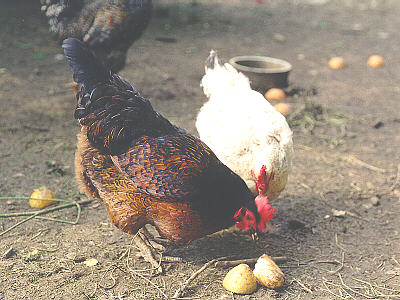
I think I may have made a vegetarian out of Jared.
So I was helping him pan up chicken for tomorrow's dinner, and I honestly wasn't expecting him to turn white at the first sight of blood followed by varying shades of green. Well leave it to me to take a bad situation and make it worse. I began entertaining him with all my chicken stories. I must say, I was proud of him. He finished the job without passing out, though the faces he made were classic.
When I lived in Africa, we raised our own chickens. A rooster crowing at 3 a.m. is a good excuse for a chicken dinner the following day and my brother and I often volunteered to see to the task. I don't mean to be morbid, but in Africa, there's not a lot to do. You quickly learn to create your own amusements. After chasing down the chicken of choice, we tied it upside-down by its feet and hung it from a tree. You know, if you don't tie down the wings, the thing will fly in circles upside down? We claimed this was to make the process of removing the feathers easier later. Then as humanly as possible, we would remove the head from the rest of the body. The next part is important. If you cut it down quickly enough, you've got about ten minutes to chase the headless bird around before it keels over. What can I say? I was ten, and I was bored.
That was about as far as I got with Jared before I knew he couldn't handle anymore. He swears he'll never eat chicken again.
Ah, the memories...
Monday, February 05, 2007
Can we dance?
I stepped into the sanctuary where ceilings rose in majesty, each upward glance increasing in splendor, the golden filigree accentuating every curve, every graceful adornment. Tall narrow windows rose from marble floor to painted ceiling filling the room with the breathless intertwining of light and color.
I stood in the center of the sanctuary, inhaling the beauty surrounding me, and as the evening progressed, I dared to ask the question that had been on my mind all night.
Can we dance?
From somewhere music began to play. From across the room of from within my mind, I cannot tell. Yet I know he also heard it. Angelic refrains joined a rhythm of pure, holy passion. I moved in closer to the one I loved.
And we danced.
As he swept me around the room, he whispered promises in my ear. Promises that stretched the span of time. Promises that came true even before he had finished speaking them. He spoke the words—I love you. And they were not a careless sentiment. The words enveloped the very essence of truth and I knew it was so.
As he took me in his arms, I loved him. As he held me by the hand, I trusted him. As he led me round the room, I followed him. As we danced.
God, can we dance?
I stood in the center of the sanctuary, inhaling the beauty surrounding me, and as the evening progressed, I dared to ask the question that had been on my mind all night.
Can we dance?
From somewhere music began to play. From across the room of from within my mind, I cannot tell. Yet I know he also heard it. Angelic refrains joined a rhythm of pure, holy passion. I moved in closer to the one I loved.
And we danced.
As he swept me around the room, he whispered promises in my ear. Promises that stretched the span of time. Promises that came true even before he had finished speaking them. He spoke the words—I love you. And they were not a careless sentiment. The words enveloped the very essence of truth and I knew it was so.
As he took me in his arms, I loved him. As he held me by the hand, I trusted him. As he led me round the room, I followed him. As we danced.
God, can we dance?
Friday, January 26, 2007
John 6
verse 2--And a large crowd was following Him, because they saw the signs that He was doing.
The Lord is my Shepherd.
verse 9--There is a boy here who has five barley loaves and two fish, but what are they for so many?
I shall not want.
verse 10--Jesus said, "Have the people sit down," Now there was much grass in the place.
He maketh me to lie down in green pastures.
verse 18--The sea became rough because a strong wind was blowing.
He leadeth me beside the still waters.
verse 20--But He said to them, "It is I; do not be afraid."
He restoreth my soul.
The Lord is my Shepherd.
verse 9--There is a boy here who has five barley loaves and two fish, but what are they for so many?
I shall not want.
verse 10--Jesus said, "Have the people sit down," Now there was much grass in the place.
He maketh me to lie down in green pastures.
verse 18--The sea became rough because a strong wind was blowing.
He leadeth me beside the still waters.
verse 20--But He said to them, "It is I; do not be afraid."
He restoreth my soul.
Tuesday, January 23, 2007
That which is hidden
This post began as a discussion with RuthAnn and continued in my mind and finally worked its way here. I'm still sorting it out. Clearly haven't come to anything ultra-conclusive.
Question: Do people really have a hidden side that no one knows about? Or do observers really have the ability to see through supposed facades and secrets that were thought hidden. Granted, everyone has secrets, and granted some people are more perceptive than others. But is it possible to have a side that is known only to the individual and kept completely hidden from the rest of the world?
I'm not just referring to specific events or experiences. Yes, these things do leave an impact on who we are, but they do not define who we are. And of course the details of experience can definitely be kept hidden. I'm talking about having actual aspects of personality that people don't know about.
However, not to take this to an extreme, I do think there are individuals who are convinced that deep down they are someone completely different--i.e. smarter, braver, kinder, more adventuresome. In reality, this identity exist only in the mind and they have never responded accordingly.
Honestly, I think it comes down to a choice. As individuals, we decide how much to open up, how far to let people see in. As observers, we choose how much we will see, how perceptive we'll be, and when to just turn a blind eye and be oblivious.
So, although I first agreed that people don't have a hidden side, that others are more aware of the hidden "us" than we like to think, the more I think on it, the more I think I disagree. I think it's possible to keep a part of self (not just experiences, but actual personality and character) completely hidden.
I'm begging to be proven wrong, so if anyone has an opinion, have at it.
Question: Do people really have a hidden side that no one knows about? Or do observers really have the ability to see through supposed facades and secrets that were thought hidden. Granted, everyone has secrets, and granted some people are more perceptive than others. But is it possible to have a side that is known only to the individual and kept completely hidden from the rest of the world?
I'm not just referring to specific events or experiences. Yes, these things do leave an impact on who we are, but they do not define who we are. And of course the details of experience can definitely be kept hidden. I'm talking about having actual aspects of personality that people don't know about.
However, not to take this to an extreme, I do think there are individuals who are convinced that deep down they are someone completely different--i.e. smarter, braver, kinder, more adventuresome. In reality, this identity exist only in the mind and they have never responded accordingly.
Honestly, I think it comes down to a choice. As individuals, we decide how much to open up, how far to let people see in. As observers, we choose how much we will see, how perceptive we'll be, and when to just turn a blind eye and be oblivious.
So, although I first agreed that people don't have a hidden side, that others are more aware of the hidden "us" than we like to think, the more I think on it, the more I think I disagree. I think it's possible to keep a part of self (not just experiences, but actual personality and character) completely hidden.
I'm begging to be proven wrong, so if anyone has an opinion, have at it.
Thursday, January 18, 2007
What's the word?
Okay, since there are a handful of word lovers who read my blog, maybe one of you can help me. What is the word that you would use to describe the incorrect use of a thesaurus. It's what every English teacher dreads while grading papers and the reason I was banned for a time from using a thesauus. It's some kind of an 'ism,' and I cannot for the life of me remember the word.
Friday, January 12, 2007
Love
I am baffled when I consider the love of God. Words like steadfast, unconditional, and sacrificial are beyond my comprehension. If our understanding of God's love comes from the experiential knowledge of what we share among ourselves, then none of us can hope to understand. Our human view is imperfect. It falls short.
After all, what is it that every individual longs for, the things in fact that he believes are his deserved right?
After all, what is it that every individual longs for, the things in fact that he believes are his deserved right?
- He wants to be understood
- He wants to be loved
- He wants to have something he can trust
Unconditional love, in its purest form, is a willingness to love without being understood. I was thinking about how that desire to be understood is something every single one of us shares, and I had to wonder is there is a single person who is understood. Unconditional love wipes out the what if's--what if I am not understood? What is my love is not returned. What if it's misinterpreted and abused? It was both anguish and comfort to my heart to read John 13 and see that Christ was not understood. Seated in the center of his dearest friends, his most intimate followers, he spoke, but they didn't have a clue what he was saying.
And yet He loved them, knowing they would not-could not understand his love, knowing they could never return his love. That's unconditional.
Steadfast love, in its truest sense, is the determination to love without being loved in return. It's the reciprocation of love that makes love easy that makes it continue indefinitely. But to be steadfast in a love that is not shared? We love the socially accepted, yet He loved the Samaritan. We love those who treat us kindly, yet He loved the Roman soldier. We don't love that way.
And yet he did. In thousands of examples, he loved the very people who despised Him. He continues to. That's steadfast.
Sacrificial love, at its highest point, is a purposeful decision to love someone you do not trust. It has to be a conscious decision; it certainly does not come naturally. I'm trying to think if there is someone who I can say I love even though I do not trust. I don't know if I want to be that honest here. I can tolerate people I don't trust. I can avoid them. I can work along side them, keeping my heart distant. But love them?
And yet, my Jesus did. Knowing he would be rejected, denied, and betrayed, he loved them. That's sacrificial.
I wish I could understand His love so that I would know how to love others. I wish I could understand so that I would know how to love Him.
Saturday, December 30, 2006
Just over nothing exists something
Warning: following is the most abstract, vague, non-committed post I have ever written. Do not expect to understand. Do not expect anything to mean what it looks like it means. If you can decipher any of it, congratulations—you know me better than I thought you did. If you do not understand it, don’t feel bad. After all, everyone must have their secrets.
Colors, sometimes bright and intense, sometimes fading into a state of near non-existence spread across the canvas of time, adding pigment to mere thought. When the brush first made a mark, it struck perplexingly. The artist should have known, should have had some concept of the finished painting, should never have made such a wayward stroke. But it seemed the brush had moved of its own accord, irresponsibly marring the image. The first mark was careless, but easily remedied, easily painted over.
The artist painted twice, three times, a forth. Each time on the same canvas. Each layer of paint concealing the previous. And when he was finished, discovered to his alarm that the painting he had hidden was more beautiful than the one that remained uncovered. The painting is framed now, hanging inconspicuously out of the way. To those that find it through effort or by mistake, it is as it appears, simple, a child’s effort made valuable only by the cost of the frame. To the artist, it is a secret, concealed for all eternity. He cares nothing for the visible product, despises it in fact. But he sees the truth. For behind the clear sky lie vibrant colors of abstract design. Between the hills now covered with trees, is a daring image he never intended for human eyes. In the depths of a still lake is the remnant of that first brush stroke. And in every other crevice are the pictures that never left the artist’s thoughts. He sees them. They are as real in his mind’s eye as if they had actually met the canvas. But alas the artist’s skill prevented them their moment.
If only. If only the artist had not doubted his work. If only he had not cared what others thought. If only the others knew what to look for. If only…but the if onlys are endless. So, as the boundaries of reality and fantasy meet and overlap, the only thought that remains is: if only the artist now had the heart to destroy the painting. And the title of the painting is as unrevealing as the painting itself: June uncovering secrets through invisible noticing.
Colors, sometimes bright and intense, sometimes fading into a state of near non-existence spread across the canvas of time, adding pigment to mere thought. When the brush first made a mark, it struck perplexingly. The artist should have known, should have had some concept of the finished painting, should never have made such a wayward stroke. But it seemed the brush had moved of its own accord, irresponsibly marring the image. The first mark was careless, but easily remedied, easily painted over.
The artist painted twice, three times, a forth. Each time on the same canvas. Each layer of paint concealing the previous. And when he was finished, discovered to his alarm that the painting he had hidden was more beautiful than the one that remained uncovered. The painting is framed now, hanging inconspicuously out of the way. To those that find it through effort or by mistake, it is as it appears, simple, a child’s effort made valuable only by the cost of the frame. To the artist, it is a secret, concealed for all eternity. He cares nothing for the visible product, despises it in fact. But he sees the truth. For behind the clear sky lie vibrant colors of abstract design. Between the hills now covered with trees, is a daring image he never intended for human eyes. In the depths of a still lake is the remnant of that first brush stroke. And in every other crevice are the pictures that never left the artist’s thoughts. He sees them. They are as real in his mind’s eye as if they had actually met the canvas. But alas the artist’s skill prevented them their moment.
If only. If only the artist had not doubted his work. If only he had not cared what others thought. If only the others knew what to look for. If only…but the if onlys are endless. So, as the boundaries of reality and fantasy meet and overlap, the only thought that remains is: if only the artist now had the heart to destroy the painting. And the title of the painting is as unrevealing as the painting itself: June uncovering secrets through invisible noticing.
Thursday, December 14, 2006
dot-to-dots
Life is like a dot-to-dot. Monumental moments, the ones that fill the pages of the baby book, the ones that send the grandmas scurrying for their cameras, are connected together by the mundane, day to day of everything else. You know what I'm talking about--graduation day, bringing home a blue ribbon, the first car, the first kiss (okay-try to keep this checkable). The first paycheck, the first time you successfully distinguish between left and right...you get the idea.
Last night, I knew a monumental moment. I experienced my very first Oahu Frappe. It was a moment I had long awaited, and I was not disappointed. Let me just say--the descriptions I had heard contained no exaggeration. And today, my life feels a little more complete.
Last night, I knew a monumental moment. I experienced my very first Oahu Frappe. It was a moment I had long awaited, and I was not disappointed. Let me just say--the descriptions I had heard contained no exaggeration. And today, my life feels a little more complete.
Tuesday, November 28, 2006
I really wish I could think of a good title for this post.
I love to write. Call me selfish, but most of what I write is for me. If I can get my thoughts on paper (or computer screen as the case may be), I can either organize them and hopefully make some sense of it all or eliminate them, thus freeing my mind from the trivial task of analyzing over nothingness. (A true analytical will appreciate that last line. The rest of you are free to roll your eyes).
All that to say: this post is not for me. It is for you, my reader; an audience which I have come to believe is rapidly diminishing. As much as that stabs at my pride, I thank you, the faithful few, who remain.
While people accuse me of being quiet, of having nothing to say, of being….horror of all horrors…amiable! I am merely observing. These are a few of my observations. I have removed all names because, well—it might be you.
People-observing ranks rather high on my list of preferred entertainments. It doesn’t get old. People are unpredictable (and predictable). People are different (and the same). The frustration with cliques is that their members only associate with their own kind. The fascination with diversity then is isolated not so much to those who observe the differences, but those who can appreciate them.
There are numbers of opposing parallels that all people posses which are simply too self-explanatory for me to expound on. For example, there is the introvert and the extrovert, the serious and the giddy, the perfectionist and the haphazardist. The list goes on. But a more intriguing pair is the profounder and the shallower. Please understand that none of these descriptions are meant to question anyone's intelligence, depth, sincerity, or motive. They are merely my observations, and thus observed through my biased perspective.
Profounders may be identified by a facial expression, but are usually identified when they speak. Few people say exactly what they mean to say, exactly when they mean to say it, exactly in the way they would say it. If they did, conversation would be dull. Instead, we have a lovely contrast of communicators. There are the few that don’t care what they say as long as they are noted for saying it. There are those who say only what everyone wants them to say. There are others who say exactly what everyone does not want them to say, which oddly is precisely what they do want in a round about way. (Yes, I know that nothing can be precise and round about at the same time. That is why I put them both in the same sentence). There are those who know they are profound and flaunt it, those who wish they were profound and try to force it, those who do not know they are profound but accidentally do it, and those who know they are profound but try to hide it in order that others might think they are more profound by hiding how profound they profoundly are.
Shallowers have a depth all their own. They are a misunderstood people, accused of being void of original thought, of being unable to think for themselves. Though many of them are highly intelligent (and many Profounders for that matter are not), they are often cast aside as intellectually unworthy. Profounders will speak of the trivial in an intellectual way. Shallowers speak of the trivial as trivially as it actually is. But Shallowers have a perspective that is unclouded by abstract logic. They have a solid understanding of what is real and what actually matters.
By the way, Shallowers are scared to death of Profounders. And though they would never call it fear, Profounders do not know the first thing to do with the Shallowers. You will seldom see these two groups mingle. But should you find yourself in the dininghall sitting at a table with a large group of Shallowers (if you are a Profounder) or Profounders (if you are a Shallower), you will need to know the difference so that you can properly appreciate the opposite group. Profounder comunication is based on content. WHAT is said is important. You can't blank out and still be part of the conversation. Shallower communication is based on the manner in which the content is expressed. It's not WHAT is said, but HOW it is said. I am convinced that a Shallower conversation can take place entirely without words. Grunts combined with expression are sufficient to have the entire table rolling with laughter.
So, may you all break out of your comfortable worlds and get to know the "others." You might be surprised what you find.
All that to say: this post is not for me. It is for you, my reader; an audience which I have come to believe is rapidly diminishing. As much as that stabs at my pride, I thank you, the faithful few, who remain.
While people accuse me of being quiet, of having nothing to say, of being….horror of all horrors…amiable! I am merely observing. These are a few of my observations. I have removed all names because, well—it might be you.
People-observing ranks rather high on my list of preferred entertainments. It doesn’t get old. People are unpredictable (and predictable). People are different (and the same). The frustration with cliques is that their members only associate with their own kind. The fascination with diversity then is isolated not so much to those who observe the differences, but those who can appreciate them.
There are numbers of opposing parallels that all people posses which are simply too self-explanatory for me to expound on. For example, there is the introvert and the extrovert, the serious and the giddy, the perfectionist and the haphazardist. The list goes on. But a more intriguing pair is the profounder and the shallower. Please understand that none of these descriptions are meant to question anyone's intelligence, depth, sincerity, or motive. They are merely my observations, and thus observed through my biased perspective.
Profounders may be identified by a facial expression, but are usually identified when they speak. Few people say exactly what they mean to say, exactly when they mean to say it, exactly in the way they would say it. If they did, conversation would be dull. Instead, we have a lovely contrast of communicators. There are the few that don’t care what they say as long as they are noted for saying it. There are those who say only what everyone wants them to say. There are others who say exactly what everyone does not want them to say, which oddly is precisely what they do want in a round about way. (Yes, I know that nothing can be precise and round about at the same time. That is why I put them both in the same sentence). There are those who know they are profound and flaunt it, those who wish they were profound and try to force it, those who do not know they are profound but accidentally do it, and those who know they are profound but try to hide it in order that others might think they are more profound by hiding how profound they profoundly are.
Shallowers have a depth all their own. They are a misunderstood people, accused of being void of original thought, of being unable to think for themselves. Though many of them are highly intelligent (and many Profounders for that matter are not), they are often cast aside as intellectually unworthy. Profounders will speak of the trivial in an intellectual way. Shallowers speak of the trivial as trivially as it actually is. But Shallowers have a perspective that is unclouded by abstract logic. They have a solid understanding of what is real and what actually matters.
By the way, Shallowers are scared to death of Profounders. And though they would never call it fear, Profounders do not know the first thing to do with the Shallowers. You will seldom see these two groups mingle. But should you find yourself in the dininghall sitting at a table with a large group of Shallowers (if you are a Profounder) or Profounders (if you are a Shallower), you will need to know the difference so that you can properly appreciate the opposite group. Profounder comunication is based on content. WHAT is said is important. You can't blank out and still be part of the conversation. Shallower communication is based on the manner in which the content is expressed. It's not WHAT is said, but HOW it is said. I am convinced that a Shallower conversation can take place entirely without words. Grunts combined with expression are sufficient to have the entire table rolling with laughter.
So, may you all break out of your comfortable worlds and get to know the "others." You might be surprised what you find.
Thursday, November 16, 2006
It feels good to breathe
I have this tendency when I'm talking to people to try to put myself in their shoes and view the world through their eyes. It's good in some ways, I suppose. Helps me understand people a little better. Helps me change perspectives. But, it's kind draining when all my friends are going through rough stuff. Seriously, all of them. Is it just me or has this been a hard year all around? And all the stuff they're dealing with is different. I don't mind, really. In fact I love it. I love being around. I love that people know they can share their heart with me. I like that they trust me. And to be honest, when I've tried to be supportive and encourage, I find that I end up being the one encouraged by the very person I was seeking to minister to.
Anyway, I've walked through the past few weeks (especially the last few days) knowing their hurt, feeling their pain, and yes, holding my breath. May I say? It feels good to breathe again.
I used to work as a camp director in San Francisco. Some of the best summers of my life. Kid's are the same all over the place. Kids like to hold their breath when they go through a tunnel. My kids were a little different because they liked to hold their breath when they went over bridges as well. None of them knew why they did it. They just did. I had a few who swore they could hold their breath the entire time crossing over Golden Gate Bridge, which by the way, in traffic, is definately impossible, without traffic, is still quite impossible. I had van drivers who would actually slow down on a bridge just for the fun of watching them turn purple.
Anyway, why did they do it? We weren't under water or driving through poisonous polution. Honestly, the van didn't smell THAT bad. I thought about it last week as I was holding my breath, waiting for the verdict, knowing that what God would do would be good, but not knowing by waht means He would work good, not knowing their response to the outcome, not knowing what my role would be as far as rejoicing with the rejoicer or weeping with the weeper, but wanting to direct towards truth, praying for wisdom. And all the while God was gently saying: Breathe in, breath out. Relax, I have everything under control.
Anyway, I've walked through the past few weeks (especially the last few days) knowing their hurt, feeling their pain, and yes, holding my breath. May I say? It feels good to breathe again.
I used to work as a camp director in San Francisco. Some of the best summers of my life. Kid's are the same all over the place. Kids like to hold their breath when they go through a tunnel. My kids were a little different because they liked to hold their breath when they went over bridges as well. None of them knew why they did it. They just did. I had a few who swore they could hold their breath the entire time crossing over Golden Gate Bridge, which by the way, in traffic, is definately impossible, without traffic, is still quite impossible. I had van drivers who would actually slow down on a bridge just for the fun of watching them turn purple.
Anyway, why did they do it? We weren't under water or driving through poisonous polution. Honestly, the van didn't smell THAT bad. I thought about it last week as I was holding my breath, waiting for the verdict, knowing that what God would do would be good, but not knowing by waht means He would work good, not knowing their response to the outcome, not knowing what my role would be as far as rejoicing with the rejoicer or weeping with the weeper, but wanting to direct towards truth, praying for wisdom. And all the while God was gently saying: Breathe in, breath out. Relax, I have everything under control.
Friday, November 10, 2006
Weeping
I know I haven’t written in forever, and I know that this doesn't count because it's not my own. But i found this quote by Spurgeon, and I like it.
"Weeping is the eloquence of sorrow. It is an unstammering orator, needing no interpreter, but understood of all. Is it not sweet to believe that our tears are understood even when words fail! Let us learn to think of tears as liquid prayers, and of weeping as a constant dropping of importunate intercession which will wear its way right surely into the very heart of mercy, despite stony difficulties which obstruct the way."
~Spurgeon
"Weeping is the eloquence of sorrow. It is an unstammering orator, needing no interpreter, but understood of all. Is it not sweet to believe that our tears are understood even when words fail! Let us learn to think of tears as liquid prayers, and of weeping as a constant dropping of importunate intercession which will wear its way right surely into the very heart of mercy, despite stony difficulties which obstruct the way."
~Spurgeon
Friday, October 13, 2006
Circumstances Crash About Me
Circumstances crash about me, and my wind struck vessel breaks.
All my thoughts are left adrift while this heart within me quakes.
Master, still my troubled mind
As you stilled the storm at sea.
Speak the words, “Peace be still,”
That from fears, I’ll be set free.
Master, still my troubled mind
As you stilled the storm at sea.
As the tempest turns to trusting,
Let me rest alone in Thee.
Enshrouded by the shadow of the valley dark and gray,
Wondering in confusion, my thoughts roam far away.
Shepherd, soothe this hurting heart
As you did with David’s song.
Whisper melodies of comfort
As the night watch stretches long.
Shepherd, soothe this hurting heart
As you did with David’s song.
Taking captive all my feelings,
Set my thoughts where they belong.
A child so small, uncertain, afraid to call your name,
Afraid to call you Abba, yet pleading just the same.
Father, take the broken pieces;
Draw me into your embrace.
Hold me close and stop the trembling;
Let me see your loving face.
Father, take the broken pieces;
Draw me into your embrace.
As I give you every heartache,
I am kept within your grace.
All my thoughts are left adrift while this heart within me quakes.
Master, still my troubled mind
As you stilled the storm at sea.
Speak the words, “Peace be still,”
That from fears, I’ll be set free.
Master, still my troubled mind
As you stilled the storm at sea.
As the tempest turns to trusting,
Let me rest alone in Thee.
Enshrouded by the shadow of the valley dark and gray,
Wondering in confusion, my thoughts roam far away.
Shepherd, soothe this hurting heart
As you did with David’s song.
Whisper melodies of comfort
As the night watch stretches long.
Shepherd, soothe this hurting heart
As you did with David’s song.
Taking captive all my feelings,
Set my thoughts where they belong.
A child so small, uncertain, afraid to call your name,
Afraid to call you Abba, yet pleading just the same.
Father, take the broken pieces;
Draw me into your embrace.
Hold me close and stop the trembling;
Let me see your loving face.
Father, take the broken pieces;
Draw me into your embrace.
As I give you every heartache,
I am kept within your grace.
Sunday, October 01, 2006
A Lesson in the City
I don't really know what made me think of this, but I was remembering back to a Saturday afternoon several years ago, when I carried a violin case all over downtown San Francisco. The reactions I received were priceless.
I walked up and down the pier with the case slung over my shoulder. Random tourists walked up to me and asked me if I was studying at the conservatory. Not this year, I would respond. I didn't bother to tell them I never would.
I juggled that thing on and off the cable car. The brake man teased me about needing to purchase a ticket for the instrument, and when I refused, told me I would have to play a tune for the ride. Several passengers joined in. I just laughed. The case never opened.
I wandered passed street musicians with an assortment of pan pipes, guitars, and native drums. A little further a small band managed to drown out the sounds of city traffic. Further, a solitary musician poured out his soul in a haunting tune on the sax. As I walked by the musicians, each noticed me. Their eyes would dart to the case and then to me, and there was an unspoken appreciation, some sort shared camaraderie that no one else was even aware of.
The whole day went like that. The whole day, I was the only one that knew that the case I carried was empty. No one ever challenged me to open the case and show the instrument. No one ever asked me to play a few notes to prove my musicianship. They just assumed.
Before you think I'm completely crazy: No, I am not in the habit of carrying empty instrument cases through the city. It just so happens there is this cute little music store in San Francisco. It's called "Lark in the Morning." I needed a new case, something that would protect my instrument a little better than what I was currently using. And that purchase had been my first stop that Saturday afternoon.
The thing that struck me though, is that I liked it. I liked the facade. I liked that I was held in a higher esteem than I deserved. I liked the association, however superficial. But carting a case doesn't make a musician anymore than attending church makes a Christian.
The truth of the matter, I do own I violin. I have studied for a couple of years, but the illustration rings true even among the saved. We are so concerned about what other Christians will think of our spirituality. If someone asks me, I'll tell them I play the violin, but I won't play for them. I don't want them to hear where I'm at. As I write this, I can see the pride screaming back at me, and I think of the verse, "Comparing themselves among themselves, they make themselves stupid." (my translation) We'll tell people we pray, but we're hesitant to pray out loud lest someone hear our fumbling words. We'll say we have a close walk with God, we can't remember when what started as a sincere relationship drifted into a ritual. We'll claim we love God, but beg God not to put us to the test to prove that love. We'll grow frustrated at the slow process of sanctification in our own lives when we see how far we have to go or when we look at the work God is doing in someone else.
It was so easy to carry the case with confidence as long as no one knew the truth. But it wasn't real.
I walked up and down the pier with the case slung over my shoulder. Random tourists walked up to me and asked me if I was studying at the conservatory. Not this year, I would respond. I didn't bother to tell them I never would.
I juggled that thing on and off the cable car. The brake man teased me about needing to purchase a ticket for the instrument, and when I refused, told me I would have to play a tune for the ride. Several passengers joined in. I just laughed. The case never opened.
I wandered passed street musicians with an assortment of pan pipes, guitars, and native drums. A little further a small band managed to drown out the sounds of city traffic. Further, a solitary musician poured out his soul in a haunting tune on the sax. As I walked by the musicians, each noticed me. Their eyes would dart to the case and then to me, and there was an unspoken appreciation, some sort shared camaraderie that no one else was even aware of.
The whole day went like that. The whole day, I was the only one that knew that the case I carried was empty. No one ever challenged me to open the case and show the instrument. No one ever asked me to play a few notes to prove my musicianship. They just assumed.
Before you think I'm completely crazy: No, I am not in the habit of carrying empty instrument cases through the city. It just so happens there is this cute little music store in San Francisco. It's called "Lark in the Morning." I needed a new case, something that would protect my instrument a little better than what I was currently using. And that purchase had been my first stop that Saturday afternoon.
The thing that struck me though, is that I liked it. I liked the facade. I liked that I was held in a higher esteem than I deserved. I liked the association, however superficial. But carting a case doesn't make a musician anymore than attending church makes a Christian.
The truth of the matter, I do own I violin. I have studied for a couple of years, but the illustration rings true even among the saved. We are so concerned about what other Christians will think of our spirituality. If someone asks me, I'll tell them I play the violin, but I won't play for them. I don't want them to hear where I'm at. As I write this, I can see the pride screaming back at me, and I think of the verse, "Comparing themselves among themselves, they make themselves stupid." (my translation) We'll tell people we pray, but we're hesitant to pray out loud lest someone hear our fumbling words. We'll say we have a close walk with God, we can't remember when what started as a sincere relationship drifted into a ritual. We'll claim we love God, but beg God not to put us to the test to prove that love. We'll grow frustrated at the slow process of sanctification in our own lives when we see how far we have to go or when we look at the work God is doing in someone else.
It was so easy to carry the case with confidence as long as no one knew the truth. But it wasn't real.
Subscribe to:
Comments (Atom)